
Florida CD-15 2020
The Takeaway
Vote Forward letters sent three weeks before Election Day can be more effective than letters sent later - when voters are (mostly) voting early
The Backstory
2020 has been quite a wild ride, in so many ways. Originally, the team at Vote Forward had planned to ask volunteers to send their handwritten letters for The Big Send one week before Election Day (November 3rd), because we aim to reach voters as close as possible to the day they choose to vote. But, as the COVID-19 pandemic pushed voters - and election officials - towards low-contact options like early voting and mail voting, we began to realize that in fact, Election “Day” might be more like Election Month. And given institutional changes at the U.S. Postal Service, plus the anticipated flood of mail-in ballots, we began to hear questions about whether we should expect our letters to be delivered more slowly - and plan accordingly.
We heard you, and we agreed: it was probably a good idea to mail letters earlier. But we didn’t want to make this decision lightly, especially because we knew that every day we moved the mail date forward was another day that volunteers would not be able to write letters. How could we gain confidence that sending the “please vote” letters early would be the right choice?
As usual, we turned to science. We took advantage of the very last primary election of 2020 to set up an experiment. In Florida’s 15th Congressional District, we sent handwritten letters to over 130,000 Democratic-leaning voters who we thought were unlikely to turn out. One-third of those voters received no letters (our control group). The remaining two-thirds were split down the middle: half of them were assigned to receive letters sent one week prior to the election date (our standard timing), and the other half were assigned to receive letters sent three weeks prior (the new, earlier timing).
We hoped that the early letters would be at least as effective as the late letters - that would encourage us that it was safe to move the mail date. Instead, to our surprise, we found that only the early letters had a significant impact on voter turnout. The effects of both letter types were smaller than what we’ve found in some of our past experiments, but only the early letters, with an impact of 0.6 percentage points, met the bar for statistical significance.
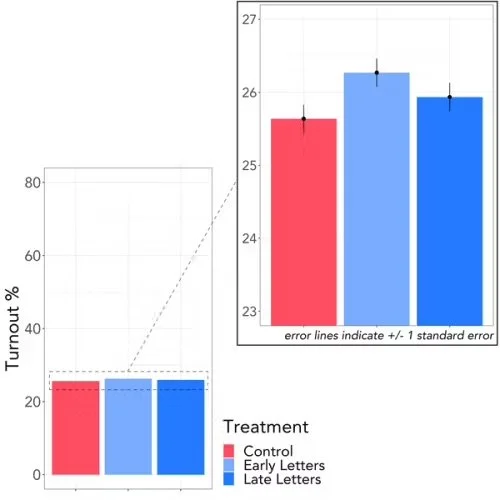
Here, voters’ choices provide a clue. Nearly 80% of the people who voted in our experiment chose to vote before Election Day - either via absentee ballot (69%) or in-person early voting (10%). This potentially means that the early letters reached registered voters when they could still choose to cast an absentee or early ballot, whereas registered voters who received late letters might only have the option to show up at the polls on Election Day. In a year when COVID-19 has made some voters wary of in-person voting, that might have been a hard sell.
Though we can’t know for sure why the early letters were more effective, one thing was clear from this experiment: we should move up the mail date! On October 17th, 2020 - a little more than two weeks before Election Day - Vote Forward volunteers sent over 18 million letters to voters across 19 states. Even with a bit less time available to write letters, volunteers smashed through our “stretch” goal of 15 million. Our data helped inform the choice of mail date, but it was the incredible energy of our volunteers that truly made The Big Send happen.
