
2020 Impact Report
2020 was an incredibly challenging year. One of the bright lights in the gloom was the incredible efforts of a huge number of Vote Forward volunteers from all over the country.
More than 200,000 of you sat down and wrote more than 17.6 million letters to voters in key states across the country. For some of you, this was only the latest in a lifetime of activism. For many others, it was your first time volunteering in an election. Your efforts left us profoundly hopeful for the future and excited to see what we can accomplish together in the years ahead.
The Big Send’s Big Impact
For The Big Send in 2020, Vote Forward randomly held out some voters from our campaigns so we could assess how much our letters affected voter turnout. Now, we’ve crunched the numbers, and it turns out that the program had a big impact. Our best estimate of the impact of the program is as follows:
0.8 percentage points
Turnout
126,000 net votes
Votes
Averaging across campaigns, we estimate that voters assigned to receive a letter voted at a rate that was 0.8 percentage points higher overall, compared to voters in the control group. To be more precise, we think the impact is most likely between 0.6 and 1.1, but 0.8 points is our best estimate.
Extrapolating this estimated impact to the entire 2020 Big Send campaign—over 14 million unique voters—translates into a gain of 126,000 votes. When we all work together, small effects turn into big results, just like the act of voting itself.
And we know: it was work. Tens of millions of letters is a whole lot of stamps, printer cartridges, and cramped writing hands. Counting all the minutes volunteers spent writing letters, we estimate that it would add up to over a century. If you were one of those volunteers—whether you contributed your days, hours, or just a few minutes—this impact belongs to you. We hope you’re proud (we certainly are!).
This estimate is based on the cleanest subset of our voter data. We also validated this finding with a smaller, even more rigorous embedded RCT analysis, which showed a slightly reduced but comparable impact estimate of 0.5 percentage points.
Many thanks to our partners at the Analyst Institute for their in-depth collaboration and review of our work. Statement from them: “Vote Forward partnered with the Analyst Institute to validate its analysis of program impact. Vote Forward allowed Analyst Institute access to voter file and anonymized program data, as well as coding scripts and output from each major stage of its GOTV program and experimentation workflow. Analyst Institute has reviewed Vote Forward’s analysis as well as independently verified its impact estimates and supports Vote Forward’s conclusions on program impact.”
Questions about this analysis? Please review the FAQs below.
Support Vote Forward & This Program
If you can, please consider making a donation to help support Vote Forward's work and the letter kits program. Each letter kit costs approximately $20 to produce and distribute.
If you've saved your payment information with ActBlue Express, your donation will go through immediately:
The Year in Review
State spotlights
Together we wrote letters to voters in 21 states in 2020, including states that hosted some of the tightest races in the country, where the electoral outcome was decided by the smallest of margins.
Letters written
State
Vote margin
Arizona
879,994
10,457
Georgia
1,550,406
12,670
Wisconsin
291,074
20,682
Source: Cook Political
Georgia Senate Runoff Elections
Vote Forward volunteers wrote an additional 2.6 million letters to voters in Georgia in advance of the critically important runoff elections for two US Senate seats on January 5, 2021.
Labs experimental results
Vote Forward is always running experiments to discover new tactics and to refine and improve our existing programs. We conduct these experiments under the banner of our “Labs” program.
This year we learned that sending letters earlier can be just as effective (Florida CD-15, Aug. 2020), that Vote Forward letters can motivate voters to vote by mail (Maine Senate primary, July 2020), and that two letters aren’t necessarily better than one (Virginia general, 2019).
You can dig into the details by checking out these reports:
Coalitions & partnerships
Our work in 2020 would not have been possible without all of our amazing partners. Of the 17.6 million letters written for the 2020 General Election, over 10 million were written by volunteers recruited by one of our 54 partner organizations.
In addition to our partner organizations, we were thrilled to work with amazing supporters like Hillary Clinton, Mandy Patinkin, Lin-Manuel Miranda and the cast of Hamilton, and so many more.
The Big Send
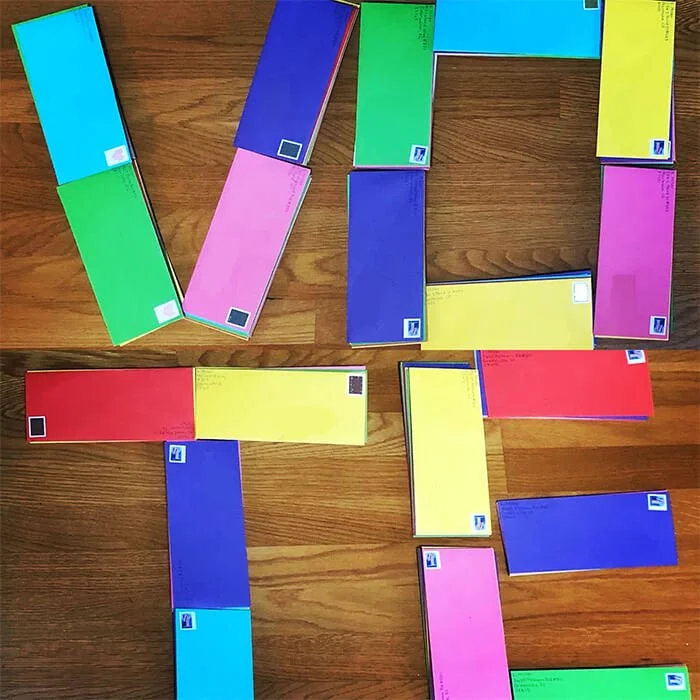
Many of you first heard about us through The Big Send — a coalition of 20 partisan and nonpartisan organizations. This group included larger national organizations like Indivisible and Daily Kos, along with regional organizations like Women for American Values & Ethics (WAVE) in Southern California and the Oregon Big Send.
The Big Send at Work
The Big Send at Work was a first-of-its-kind coalition of businesses who partnered with Vote Forward to help encourage all Americans — including their employees, customers, and broader communities — to vote in the 2020 elections. Nearly 40 companies participated, including Patagonia, PayPal, Change.org, Fenwick, and Rachel Comey.
Thank you to our volunteers
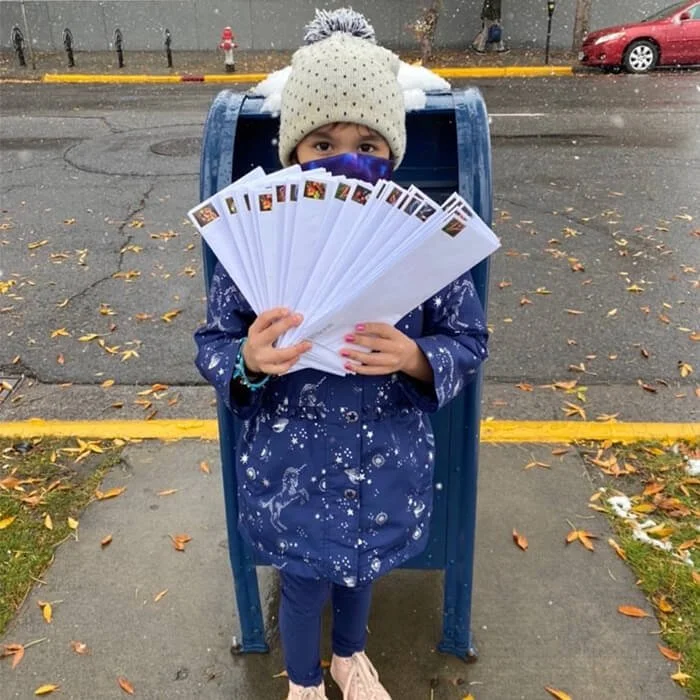
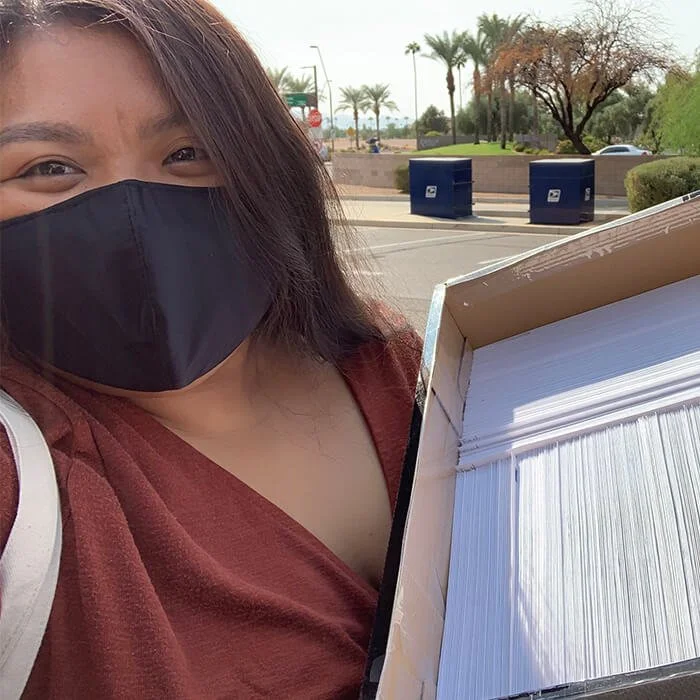
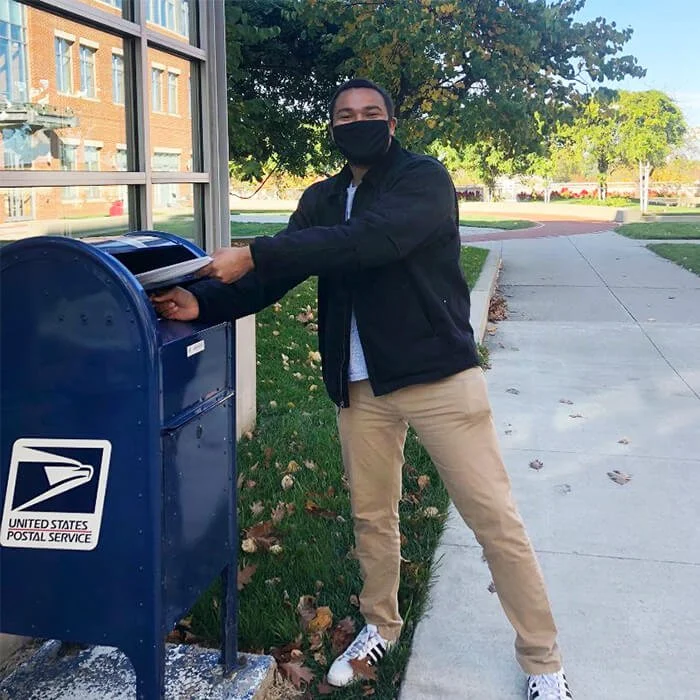
None of this would have been possible without our amazing volunteers. We are honored that you chose to join the Vote Forward community this year!
“My son was an election worker in a north Austin precinct. A young man, on entering the polling place, announced that he was voting because someone sent him a handwritten letter encouraging him to cast his ballot. He said he was so impressed by the letter he convinced a friend to come along with him to vote too.”
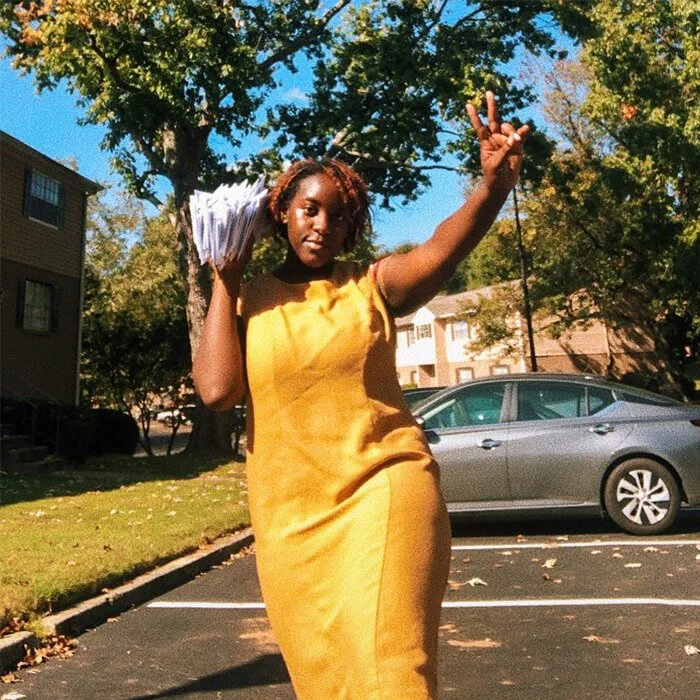
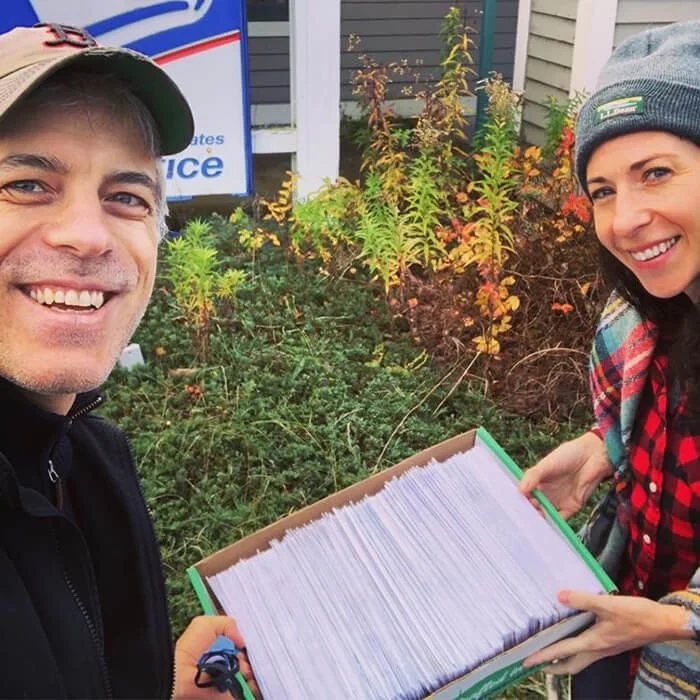
“I received one of your Vote Forward letters from Maria E in Indiana, Pa and I must say this was a pleasant surprise. It was such an unbiased and positive reminder. I’ve voted once before, I didn’t vote the last election and felt absolutely horrible. This year I am registered to vote but haven’t sent my ballot in. This letter was the motivation I needed to do so.”
Frequently Asked Questions
-
Our analysis shows that the Vote Forward community contributed meaningfully to the election results, but the historic levels of voter turnout we saw in 2020, and the specific results of each race, happened for many reasons. A huge community of organizations and individuals worked incredibly hard to impact this election, and we’re proud to count ourselves among them.
-
For an individual person, we actually can’t know that. Our findings show that overall, the letters you wrote encouraged more voters to turn out, but we can’t tell exactly which voters were the ones who otherwise wouldn't have cast ballots.
-
Since each batch of voters each volunteer adopted was randomly selected, you might end up writing to a bunch of people who all go out and vote, or a bunch of people who don’t, simply due to chance. The key fact is that on average, when we combine all of our efforts and all of our data, we see that Vote Forward letters boost voter turnout.
-
The main reason is that we were dependent on all the finalized election data becoming available before we could perform the analysis, which in this case took many months. We’re also a small team! It was a very complicated project, and we wanted to make sure we got it right.
-
There are two ways of thinking about this. One is from the perspective of Vote Forward’s operating budget — i.e., the cost of employing our team and maintaining the program. When we divide our 2020 operating budget by our best estimate of the number of net votes we caused, we estimate a cost-per-net-vote (“CPV”) of $14. This is the number that donors to Vote Forward are most interested in, because it helps them understand and compare the impact of their contributions.
The other is from the perspective of volunteers, for whom Vote Forward's internal costs aren't a factor. Instead the relevant costs include postage, supplies, and printing. It’s likely that the CPV from the volunteer perspective is higher than $14, but we have not yet completed calculating the exact figure. Our best estimate of the impact of our 2020 program (0.8 percentage points) is conservative, considering the impact of a voter being “assigned to treatment” — i.e., eligible to have received a letter. But not all of them actually did! Some voters were never adopted, and for others, the letters weren't completed or sent. Plus, some voters received multiple letters. The second (and more complex) phase of our analysis will attempt to disentangle these factors.
Whichever way you look at it, Vote Forward is highly cost-effective compared to the best-studied tactics for increasing voter turnout. GOTV efforts in presidential elections often struggle to reliably produce net votes at all, for any amount of money, so CPVs of hundreds of dollars or even $1000+ are typical.
Note that this is cost per net vote — votes cast as a result of the Vote Forward program that otherwise would not have been cast. Sometimes we see claims based on the cost per vote total, which is a very different and misleading measure because it counts votes regardless of whether they were caused by the program. We recommend that when you are researching different programs, you should look to make sure they are reporting their cost results based on net votes.
Support this work
Vote Forward is a small and efficient nonprofit organization, and we rely on grassroots donors to help fund our work. Make a donation today to help support our team, our Labs Program, and future letter writing campaigns!