
2025 Results
From the beginning, the Vote Forward community has done things differently. A commitment to innovating, testing, and transparently sharing results has been a part of Vote Forward’s DNA from the organization’s inception.
We’ve never been content to assume that what’s worked in the past will always work in the future. That’s why we’ve built our programs on scientific testing and committed ourselves to sharing all of our results—good, bad, and in between—with the entire community.
2025 gave us an opportunity to learn from off-cycle elections. Since neither a presidential or midterm election is taking place, off-cycle elections are often less salient for voters and usually have significantly lower turnout.
Last year, Vote Forward ran four campaigns. Across all the campaigns, over fifteen thousand volunteers adopted nearly one million voters, an incredible effort & reminder that we truly couldn’t do this work without our community of volunteers.
After receiving the data on who voted and who didn’t and analyzing the results, the Data & Research team at Vote Forward are ready to share the impact of our work together in 2025. TL;DR: Vote Forward’s letters still increase turnout, but they work best when the contact feels new or different—reaching voters who haven’t recently received letters or using novel messages—while repeated outreach appears to lose effectiveness without producing backlash.
Each campaign differed in who was targeted, the type of election, the content of the letters, and whether the campaign was a nonpartisan or political campaign. Despite these differences, we are able to holistically examine the slate of campaigns and the findings from our studies to inform the next steps of Vote Forward.
Social pressure letters (Alameda + LA)
Key Findings:
Across all campaigns, our analysis revealed insights we’ll incorporate into future campaigns. Our topline findings are:
Receiving a letter appears to most effectively mobilize turnout when the treatment is novel, for example when:
A person was not sent a letter in that election cycle
The letter includes a different or “additional” message, such as sharing information about a voter hotline or invoking social pressure to encourage turnout.
There is not a one-size-fits-all for targeting races. We learned that letters are effective for some target audiences but not others in the same race. There may be features of particular populations, races, and news cycles that shape this heterogeneity.
We do not see evidence of backlash of any of our campaigns, even among those who receive repeated letters for one election shortly after another, or for voters who received social pressure messaging.
Incorporating these findings into our future programs is what will continue to improve the impact of volunteer time and money.
In the upcoming year of Vote Forward, we will:
Test novel interventions that layer new tactics onto classic letter-writing campaigns
Test the effectiveness of letters in low-salience and/or state and local elections, given our continued encouraging results in these contexts.
Investigate how the targets of a campaign shapes effectiveness.
Continue the iterative testing that we are known for to constantly push innovation in tactics and deepen our understanding of how different features of a race influence letter-writing effectiveness.
Wisconsin 2025 Supreme Court
What did we do?
We sent letters to 251,078 voters in Wisconsin ahead of the 2025 Supreme Court race. There was a social and political campaign, both fully adopted, with lots of volunteer energy.
What did we test?
In addition to testing the effectiveness of letters on turnout, we designed our study to determine whether the effectiveness of letters differed between (a) those who received letters in 2024, (b) those who did not receive letters in 2024 but were in our target audience, and (c) those who were new to target send list.
What did we learn?
In the political campaign, letters were highly effective among those who were in the target audience for 2024 but did not receive letters in 2024. For the same group, letters sent in the social campaign trended in the right direction, but the experimental results are noisier.
There were mixed results for both the social and the political campaign for letters written to new targets who were not in the target list for the Big Send in 2024. These are voters who were not in the voter file when we set the targets for the Big Send, but appeared in the voter file prior to the 2025 campaign.
For both the Social and Political campaign, letters were ineffective for people who received letters in the Big Send. At the same time, we do not see evidence of backlash to our letters. For these voters, letters neither harmed nor helped turnout.
This establishes some preliminary evidence that voters become habituated to the letters. We will take this learning and consider voter fatigue in future outreach efforts.
Pennsylvania 2025 Supreme Court
What did we do?
We sent letters to voters for the Pennsylvania Court election. This letter introduced reciprocal contact between voters and volunteers, allowing voters to reach out via URLs and QR codes shared in letters to seek further information.
What did we test?
We tested the effectiveness of letters with a reciprocal contact program on turnout.
What did we learn?
We estimated effects of between 0.3 and 0.5 percentage points on turnout. While on the small end, these effects are consistent with smaller effect sizes over time for other traditional voter contact tactics (as increasing tactic adoption leads to saturation of the control group), and still showed a significant increase in turnout for the political campaign.
We saw some utilization of the hotline, and its inclusion in the letters may have had an effect. In this campaign, we cannot measure the effectiveness of reciprocal contact relative to standard letters; we hope to explore this in the future.
California Prop 50 Letters
What did we do?
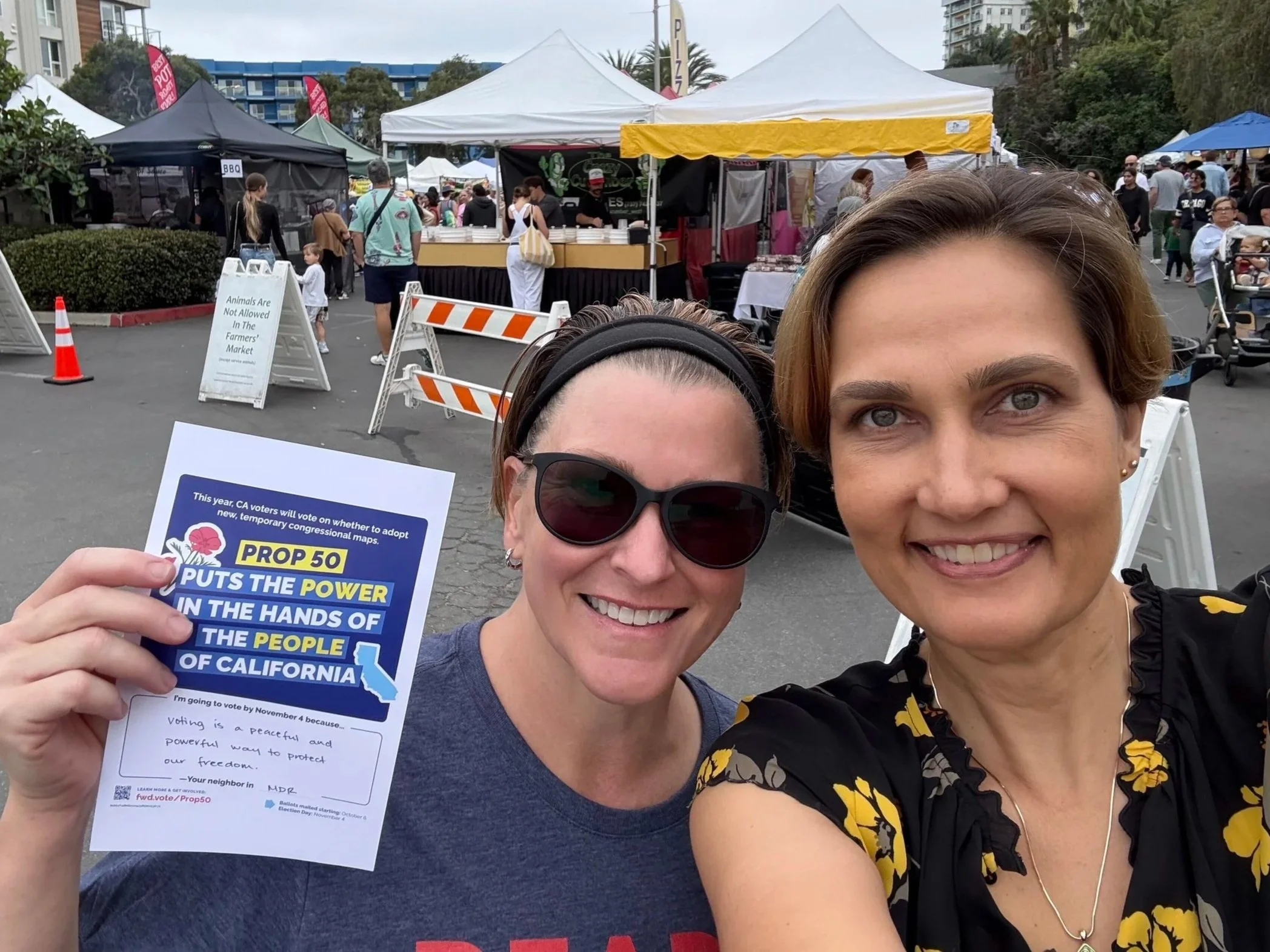
We sent letters to voters ahead of the Prop 50 redistricting vote. This campaign was under-adopted, and the Prop 50 vote was a high turnout special election.
What did we test?
We tested the effectiveness of handwritten letters on turnout. The campaign used a new template design with more graphical elements, but we did not test the effectiveness of the new template compared to past templates.
What did we learn?
We saw null effects, but in the context of an under-adopted and under-powered campaign in a salient and high turnout special election.
California Prop 50 Letters: Social Pressure
What did we do?
We sent letters in Alameda and LA counties ahead of the Prop 50 vote, targeting Black voters in these two counties. The campaign itself was under-adopted and under-powered, making it difficult to learn conclusively from this test.
What did we test?
We compared the effectiveness of handwritten letters to no letters, and to letters that contained a social pressure message.
What did we learn?
The results of both campaigns trended positive, with preliminary evidence that the social pressure messaging was more effective than the traditional template. We saw a +0.8pp (but non-significant) increase in turnout for the social pressure messaging, compared to the control group.
For the non-social pressure letters, we saw a +0.3pp (but non-significant) increase in turnout, compared to the control group.
While all results in California were not statistically significant, the impact in effects and targeting is illuminating and suggest the need for future research into the dynamics of social pressure messaging. These results do, however, suggest that more testing is needed before scaling up.
