
Virginia 2021
Our impact in Virginia’s 2021 elections
The Takeaways
Letters produced small gains in Virginia’s high-profile elections
Layering different letter types didn’t seem to add more impact
The Backstory
In the world of U.S. politics, the odd-numbered years between big national election cycles are sometimes called “off” years, but there are plenty of interesting and important elections that happen during those “off” years. Many critical elections took place in 2021, including in Virginia, where voters chose their next delegates, local officials, attorney general, and governor. This high-profile election offered an opportunity to try out two tactics in one: “vote by mail” (VBM) letters that arrive earlier before Election Day, and our tried-and-true “please vote” letters. We’ve tested each of these tactics separately in the past, and we had a hunch that they’d play well together in a combined program. VBM letters can help provide info to voters early, while they still have plenty of options for casting a ballot, while “please vote” letters are sent later, to reach voters right before the Election Day deadline.
As in 2020, we ran two campaigns: a Social Campaign and a Political Campaign. In the Social Campaign, all 560,000 voters in the campaign were set to receive VBM letters, and half of them were set to also receive a “please vote” letter closer to Election Day. We also held out about 62,000 voters as a control group, so we could analyze the impact of the campaign. (Wondering what a control group is? Check out our FAQs!)
According to our post-election analysis, Virginia voters who received letters voted at a higher rate than those who didn’t, by about a third of a percentage point (+0.30 - 0.35 points). Comparing the light blue and dark blue bars in the following graph, we don’t see evidence that the combined VBM and “please vote” (GOTV) letter program was more effective than VBM letters alone at boosting turnout.
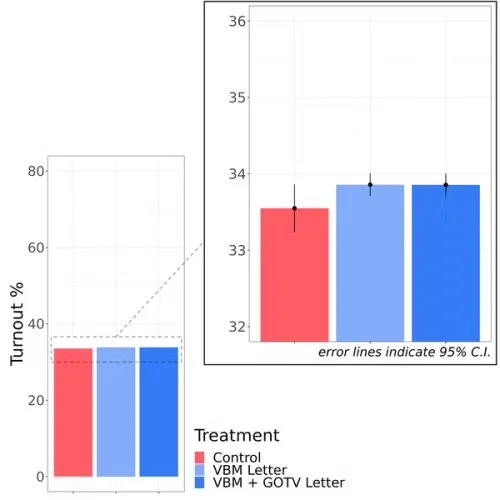
[Image shows a bar graph with three bars colored red, light blue, and dark blue, representing turnout in each experimental condition. The red bar represents turnout for the Control group, the light blue bar represents turnout for voters who received the VBM letter, and the dark blue bar represents turnout for voters who received both VBM and “please vote” letters. Both blue bars are about the same height, and they are slightly higher than the red bar.]
While we’re excited to show that the letter campaigns did impact Virginia voters in 2021, there’s definitely still more to learn. One question on our minds is how the unique context of Virginia’s elections may have affected the results we saw. This election turned out to be very high-profile, attracting lots of media coverage and political investment—potentially making it harder for any program to stand out. We also wonder how the timing of letters might play a role: In a past Virginia campaign, we sent letters just one week before Election Day, whereas in 2021, we sent letters between 2.5 and 6.5 weeks in advance. Is it possible to send letters too early?
To help shed more light on this question in 2022, we’ve launched a Vote Forward Labs campaign in Minnesota’s 1st Congressional District to study letter timing. If you’d like to help (and turn out voters in a critical special election for the U.S. House), you can write letters for this campaign between now and August 2.
Thanks, as always, to all the volunteers who helped us achieve impact in 2021! This year, there are more important elections coming up, and millions more voters we can reach. To pitch in with The Big Send, head over to our campaigns page, choose where you want to make an impact, and start writing!
